Memoirs of the Harpswell Cottages
By Lena Towle Salomon 1954
‘I first heard of Harpswell in the summer of 1888 . . . My grandfather, Calvin Turner Towle, knew that the George Merriman family of West Harpswell sometimes took “roomers and boarders” in the summer. He wrote to them and it was arranged that my mother, Cora Bunker Towle, Beulah and myself should spend the summer at the Merriman farm.
We were driven to Harpswell from Lewiston by my father, Walter Chase Towle, in grandfather’s top buggy. . . The jolting ride down the rocky crossroad to the farmhouse was quite terrifying to Beulah and me.
So many of my memories of Harpswell are interwoven with the Merrimans who were delightful people of old New England stock. The father was a great favorite of mine, gentle and humorous. The mother was the former Lydia Stover of North Harpswell, pretty and very ladylike, whom we all called “Lydie”.
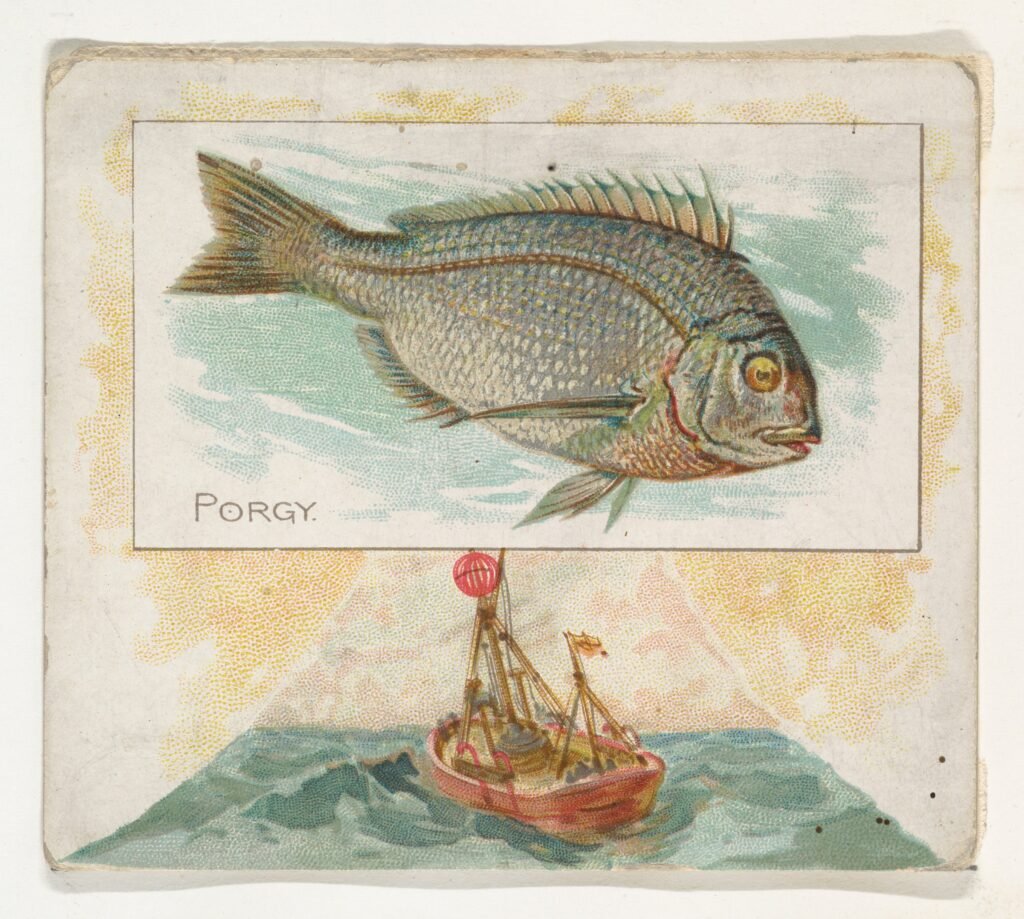
The farm at that time was virtually a self-sufficient community, as most Maine farms were then, and some still are. Since it was on the coast, however, the sea as well as the land provided the living. That first summer and for several years George and his neighbor, Charles Hinkley, were concentrating their combined energies on catching porgies which they hauled by nets. These nets were set in the evening and were hauled about daybreak, because the seals (abounding in the bay) would tear the nets as they stole the fish when daylight broadened. Even so, there was an almost daily task of repairing to be done after the nets had been spread and dried on the grassy banks.
The porgies were slivered to remove their fatty sides and the remainder discarded to be used as fertilizer on the land – an old colonial custom. These slivers were salted and “packed” in barrels ready to be sold at Prince’s Point, Orr’s Island, as bait for deep sea fishing. After the porgies had been attended to George would haul his lobster traps while Charles returned to his own farm duties. By 11 a.m. we children were usually waiting with him at the fishhouse for Lydie’s dinner call.
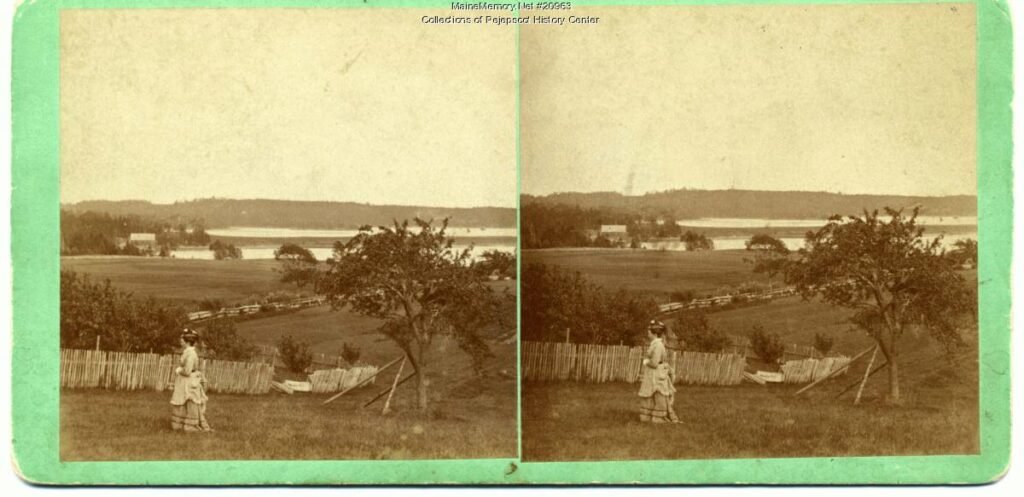
Beulah and I had never been in the country or at the seashore before and were fascinated by the spacious well-kept farmhouse; the big barn filed with sweet hay and containing a great rope swing; the woods, where we made houses carpeted with soft moss and inlaid with wild pink rosebuds; the wharf: the boats, and the fishermen’s daily activities.
We spent many evenings visiting and laughing in the cheery kitchen and listening to George tell tales of his experiences aboard sailing ships, or his trips to Grand Manan and the Bay of Fundy for fish. Sometimes he could be persuaded to sing old ballads but not often. One I remember was a long, long story of how the blackfish came into a cove on Orr’s Island and were stranded there. They were killed by people armed with every weapon that could be seized quickly.
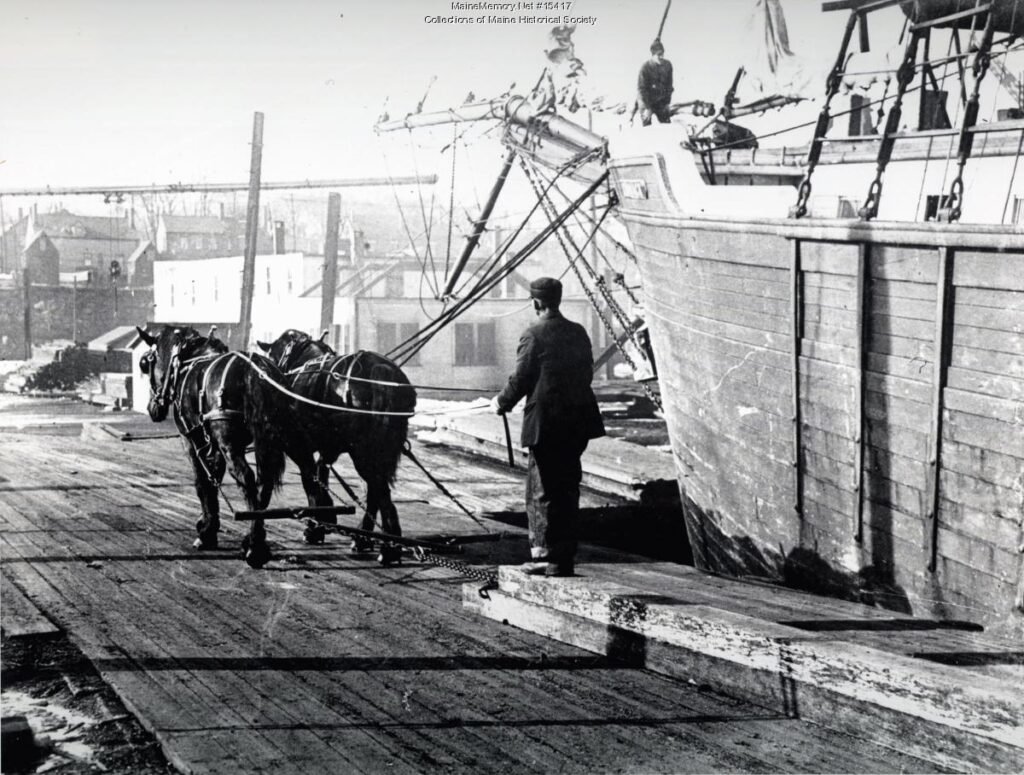
Sometime around 1894 we had begun to travel by the Maine Central Railroad from Lewiston to Brunswick, then down to Harpswell Neck by the “Stage” which carried mail and passengers. We were dropped off at Captain Daniel’s fine house at the head of our crossroads, whence we walked to the shore, leaving our luggage to be brought down in a wheelbarrow later. In later years we made the journey by railroad to Portland and then by the steamer “Merriconeag” (365 Island Route) to the boat landing at South Harpswell. There all boats were met by local drivers who carried us and our luggage in varied horse-drawn conveyances to the cottage door. While we waited in Portland for the afternoon boat to leave, my mother annually made a trip to Goudy & Kent’s Wholesale Bakery. There she bought a box of their cookies which were put aside because broken, overcooked or misshaped. The box, holding about a halfbarrel was a feature in the cottage all summer and was free for us children at all hours for lunching.
Sometimes we were allowed to walk to Moses Bailey’s store at West Harpswell on errands or to make our small purchases. We preferred to take the cart roads and foot paths around Reddick’s Cove over the stile at the Hinkley farm, through the spruce woods and up the main road by Rufus Merriman’s house (now Ed Leeman’s). One memorable day we had been sent to get a hand rake for George and a jug of molasses for Lydia. Beulah and Albert thought it would be a good idea to put the rake handle through the jug handle and carry it between them. Somebody stubbed a toe, the rake fell, the jug broke and great was the consternation. I believe Mr. Bailey trusted us for another jug of molasses which was carried more carefully.
Before Rural Free Delivery was instituted we called for our mail at the postmaster’s at West Harpswell. The mail for points below there came by steamboat to the post office at South Harpswell.
One Sunday, with my classmates Alice Cartland and Lincoln Roys, we attended service at the Congregational Church at Harpswell Center. The Rev. Elijah Kellogg, retired pastor, preached the sermon. The boys were most interested in the fact that the preacher was the famous author of one of their favorite declamations, “Spartacus to the Gladiators.” The old cemetery with its slate headstones was a fascination for us also.
Once we hired a cottage at Did Orchard Beach to give the children the benefit of sand and warmer bathing but none of us liked the place as well as Harpswell.
About 1925 Mrs. Bibber had written that Joseph Stover and J. Albert Curtins (his nephew) were offering for sale nine shore lots of their Harpswell property and she believed I should be interested. Lots 4 and 5 on their plan was the knoll overlooking Harpswell Sound and Stover’s Harbor with its fine view of Orr’s and Bailey Islands. This was one of my favorite sites, also known and beloved by George Merriman. Jake immediately purchased the two lots for $150 each but it was not until 1939 that our new cottage was built. Jake brought down a crew of nine men from Groveton and the cottage was built in 10 days, the lumber being brought from Brunswick by truck over the farmhouse road and. by permission, over Mr. Douglas’s land. The workmen were boarded by Harry Bibber. I named the cottage “Merryknoll”, in part for George Merriman and in part for its physical aspects, although Jake ~ways referred to it as “Lena’s Ledge” and had a sign painted with this on it.
For some time after Merryknoll was built we continued to use kerosene for our lamps and wood stoves. By 1950 Mrs. Kenson Merrill persuaded several other cottage owners, including Beulah and myself, to agree to have the Central Maine Power Co. extend their line from the Clark farm on the so-called “Mountain.” After the electricity was brought in, Noel Salomon, with the able assistance of Leonard Kane and Richard Salomon, wired both cottages so we had lights and “progress was no longer obstructed.” Marguerite provided the first refrigerator for Merryknoll and the next year, with Frances, provided one for Oak Cottage. Electric grills were next installed for cooking and heating water, plus a radio for Guy Lombardo’s music and the New York City baseball games.
From the beginning we had rocky roads to travel from the main highway to the shore. Our right of way was the road past the Merriman farmhouse, although some years the road across the Jackson property was considered slightly better. Gradually, however, we came to use the Mountain road, contributing small sums annually to its upkeep.
With the passage of the years marked changes have taken place in the marine life along the shore. When I was a girl clamming was a major occupation at all seasons. Barrels of them were dug every winter at Reddick’s Cove and hauled by the cart road across the pastures to the Merriman fishhouse. Now clams in any quantity have practically disappeared. From the wharf and from Cunner Rock we were able to catch small fish such as cunners, flounders, tomcod and eels. Today these fish are scarce; no one bothers to throw a line into the water though some are caught in seines off Merriman Ledges for lobster bait. Lobsters are still plentiful and lobstering is a profitable business since laws are protecting the industry. I recall how very proud my mother was when she learned to knit “heads” for lobster traps under the tutelage of Lydia Merriman.
The “Age of the Automobile” has largely eliminated travel by water. We used to set our clocks by the Gurnet, an excursion boat which every day sailed from Portland to the Gurnet House on Great Island. This was taken off in the 1940’s and only recently the Aucocisco (successor to the Merriconeag) ceased to call at South Harpswell and the boat landing there has been demolished.
About 1925 Mrs. Bibber had written that Joseph Stover and J. Albert Curtins (his nephew) were offering for sale nine shore lots of their Harpswell property and she believed I should be interested. Lots 4 and 5 on their plan was the knoll overlooking Harpswell Sound and Stover’s Harbor with its fine view of Orr’s and Bailey Islands. This was one of my favorite sites, also known and beloved by George Merriman. Jake immediately purchased the two lots for $150 each but it was not until 1939 that our new cottage was built. Jake brought down a crew of nine men from Groveton and the cottage was built in 10 days, the lumber being brought from Brunswick by truck over the farmhouse road and. by permission, over Mr. Douglas’s land. The workmen were boarded by Harry Bibber. I named the cottage “Merryknoll”, in part for George Merriman and in part for its physical aspects, although Jake ~ways referred to it as “Lena’s Ledge” and had a sign painted with this on it.
For some time after Merryknoll was built we continued to use kerosene for our lamps and wood stoves. By 1950 Mrs. Kenson Merrill persuaded several other cottage owners, including Beulah and myself, to agree to have the Central Maine Power Co. extend their line from the Clark farm on the so-called “Mountain.” After the electricity was brought in, Noel Salomon, with the able assistance of Leonard Kane and Richard Salomon, wired both cottages so we had lights and “progress was no longer obstructed.” Marguerite provided the first refrigerator for Merryknoll and the next year, with Frances, provided one for Oak Cottage. Electric grills were next installed for cooking and heating water, plus a radio for Guy Lombardo’s music and the New York City baseball games.
From the beginning we had rocky roads to travel from the main highway to the shore. Our right of way was the road past the Merriman farmhouse, although some years the road across the Jackson property was considered slightly better. Gradually, however, we came to use the Mountain road, contributing small sums annually to its upkeep.
With the passage of the years marked changes have taken place in the marine life along the shore. When I was a girl clamming was a major occupation at all seasons. Barrels of them were dug every winter at Reddick’s Cove and hauled by the cart road across the pastures to the Merriman fishhouse. Now clams in any quantity have practically disappeared. From the wharf and from Cunner Rock we were able to catch small fish such as cunners, flounders, tomcod and eels. Today these fish are scarce; no one bothers to throw a line into the water though some are caught in seines off Merriman Ledges for lobster bait. Lobsters are still plentiful and lobstering is a profitable business since laws are protecting the industry. I recall how very proud my mother was when she learned to knit “heads” for lobster traps under the tutelage of Lydia Merriman.
The “Age of the Automobile” has largely eliminated travel by water. We used to set our clocks by the Gurnet, an excursion boat which every day sailed from Portland to the Gurnet House on Great Island. This was taken off in the 1940’s and only recently the Aucocisco (successor to the Merriconeag) ceased to call at South Harpswell and the boat landing there has been demolished.
Life at Harpswell has always been placid and restful with little excitement to mar the march of days. The day after war was declared between England and Germany in 1939 I had the thrilling experience of seeing the “Queen Mary,” already converted to a troopship in her gray battle dress, slipping across the open sea beyond Bailey Island as she made her way home by the Great Circle Route.’